Tiankai Guo
What drew you to the Georgetown MS Data Science and Analytics program?
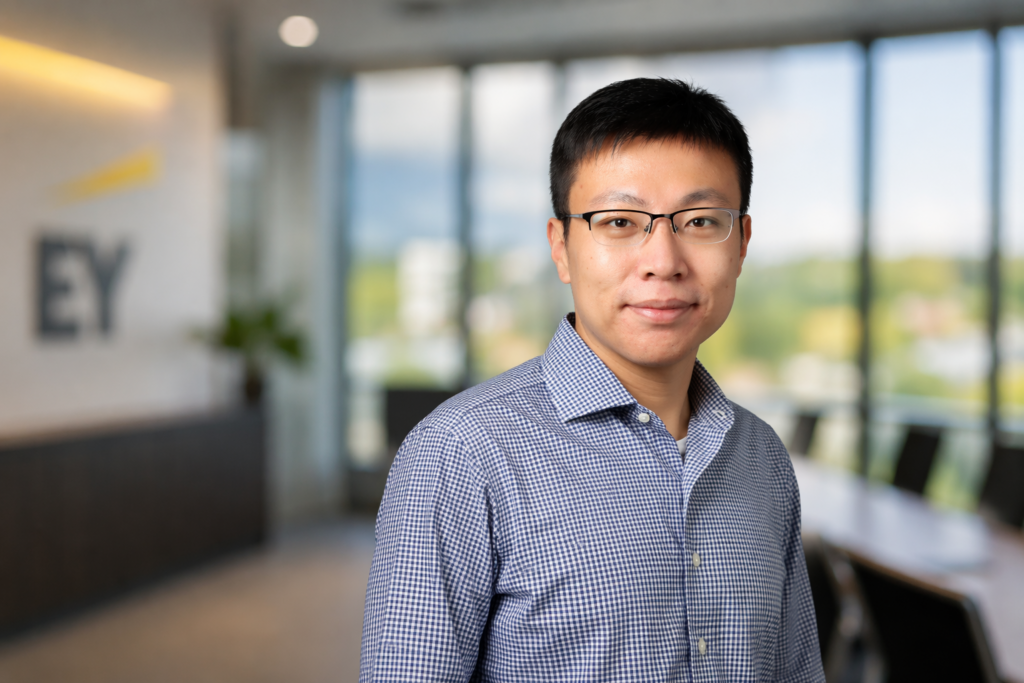
I was looking for a program that combined rigorous technical training with practical business applications. Georgetown stood out because of its strong industry connections and its balanced curriculum spanning machine learning, statistics, and analytics. I wanted to develop solutions that not only deliver accurate models but also drive meaningful impact.
What was the best career advice you received while in the DSAN program?
One piece of advice that stayed with me was: Don’t just solve the problem you’re given, understand the business problem behind it. As a data scientist, it’s easy to focus on algorithms and model performance. But the biggest impact comes from asking the right questions, understanding stakeholders’ needs, and building solutions that people will actually use.
What was your favorite DSAN course at Georgetown?
My favorite course was Big Data and Cloud Computing, taught by professor Marck Vaisman and professor Irina Vayndiner. It was one of the most practical courses in the program because it focused on building scalable data solutions using cloud technologies rather than just developing machine learning models.
The course gave me a solid foundation in cloud architecture, distributed computing, and data engineering principles. Looking back, those skills have become even more valuable as AI applications have grown in scale. Today, whether I’m building AI solutions at EY or developing AI agent systems, I rely on many of the concepts I learned in that class to design scalable and production-ready systems.
Do you have any advice for current DSAN students?
Don’t limit yourself to coursework. Build projects, participate in competitions, contribute to open-source projects, or create something you’re passionate about.
The AI field moves fast, so keeping your curiosity and continuous learning is essential. Also, the ability to explain complex technical ideas to non-technical stakeholders is just as important as writing great code. The combination of technical depth and business understanding is what will set you apart.
How do you use AI in your work at Ernst and Young?
At EY, I use AI in several ways. Internally, we build predictive models and analytics solutions that help improve business decisions and operational efficiency. More recently, generative AI has become a key part of our work. We use large language models to accelerate knowledge discovery, automate repetitive tasks, and help consultants access information more efficiently.
AI also helps me personally. I use it to prototype ideas faster, generate code, summarize documents, and brainstorm solutions, allowing me to spend more time on higher-value problem solving.
What are you working on now?
Besides my work at EY, I’m building an AI Agent platform.
The goal is to help engineering teams solve complex technical problems more efficiently. Instead of simply answering questions, the system combines enterprise knowledge, structured workflows, and AI agents to guide engineers through root cause analysis and decision-making. It’s exciting because we’re moving beyond chatbots toward AI systems that can actually collaborate with experts on complex engineering tasks.
If you could have any superpower what would it be, and why?
I’d choose Doctor Strange’s ability to see millions of possible futures.
As a data scientist, I think that’s the ultimate decision making superpower. Whether you’re building AI systems, launching a startup, or solving complex business problems, you’re constantly making decisions under uncertainty. If I could instantly evaluate millions of possible scenarios and identify the one with the highest chance of success, it would completely change how I approach innovation and strategy.
Of course, in real life we don’t have magic, but that’s one of the reasons I’m so excited about AI. In many ways, AI helps us approximate that superpower by analyzing massive amounts of information, exploring possibilities, and supporting better decisions. That’s what motivates me in my work.